Motorized blinds are the upgrade everyone wants and almost nobody prices before they fall for it. You see the demo, the shades glide down at sunset, then the quote lands and the conversation stops. Right behind the sticker shock come two more worries: will I be up a ladder charging batteries every month, and will this thing actually talk to my Alexa, my Google Home or my iPhone?
This motorized blinds buying guide answers all three. What a motor adds to your day, what it adds to the price (in Canadian dollars, dated, with the motor premium pulled out on its own), how the battery holds up, and a plain compatibility list for the one motor we sell. There's also a section on who should skip motorization, because for a lot of windows the honest answer is "not this one."
Every product detail below comes from our own motorization page and live configurator as of 10 October 2026, and every price is dated.
What Motorization Actually Adds
The obvious part is that you stop pulling chains. The less obvious part is what you start doing instead.
Schedules. Your bedroom shade lowers at 9 p.m. and rises at 7 a.m. whether you remember or not. A west-facing living room closes at 3 p.m. in July. Schedules, scenes and voice all run through the Smart Life app (details, and the hub you need, in the compatibility section below).
Groups. Three windows in a row move as one. Our remotes control shades individually or in groups, up to 16 channels plus custom groups, so you can run a room from the nightstand without opening your phone.
Reach. This is where motorization stops being a luxury. A window over a stairwell, a two-storey great-room wall, a floor-to-ceiling condo pane behind a sectional. If you can't reach the chain, you don't use the shade, and a shade you don't use is money on the wall. Our post on when motorizing makes sense covers these situations, and our condo measuring guide covers tall windows.
Accessibility. For anyone with limited grip or mobility, a chain is a daily obstacle and a button or a voice command removes it.
No cords at all. No chain, no cord, nothing to loop. With small children or pets, that's not a bonus feature, that's the feature.
Quiet. Our motors run at around 32 dB, roughly a whisper. You'll hear it in a silent bedroom, not over a conversation.
Who gets the most out of it: homes with many or very tall windows, people who already run a smart home, and anyone for whom reaching a chain is a problem rather than a chore.
The Real Costs (CAD, 2026)
These are our prices as of 1 November 2026, pulled from our live configurator that day. Every price below is our sale price: 50% off our retail price. Watch for promotions, which can take it lower still at checkout.
The motor premium, isolated. On any of our roller, zebra or cellular shades, the motor adds a fixed amount per shade. It doesn't scale with the size of the window.
- Roller or zebra, motor instead of chain: +$495.00 per shade
- Custom cellular, motor instead of glide chainless: +$355.00 per shade (cellular shades include the chainless lift as standard, so the step up to a motor is smaller)
Motor accessories, bought once. None of these are per-window.
- Remote: +$95.00 (one remote runs up to 16 channels, so one per home or per floor is typical)
- Connector+ Hub: +$225.00 (needed for app control, schedules and voice; one per home)
- Charger: +$30.00 (optional; see the battery section)
Standard vs. motorized, per window. Roller shades, chain control, open roll, from our lowest fabric group to our highest, with the motor added:
- 24" wide × 36" tall: chain $88.00 to $146.00, motorized $583.00 to $641.00
- 36" × 60" (a typical bedroom window): chain $186.00 to $361.00, motorized $681.00 to $856.00
- 48" × 60": chain $236.00 to $472.00, motorized $731.00 to $967.00
- 60" × 72" (a typical living room window): chain $291.00 to $630.00, motorized $786.00 to $1,125.00
- 72" × 84": chain $422.00 to $901.00, motorized $917.00 to $1,396.00
For the other two product lines on the same 36" × 60" window, same date: a zebra blind in our entry fabric group with a compact cassette runs $351.00 with chain and $846.00 motorized. A custom cellular shade in our entry fabric group runs $409.00 with glide chainless and $764.00 motorized.
Multi-window math. Because the remote and hub are bought once, the per-window cost drops as you add windows. Five 36" × 60" rollers in our entry fabric, motorized, with one remote and one hub: $3,725.00. The same five on chain: $930.00. That's a premium of $2,795.00, or $559.00 per window including the shared accessories. Motorize one window with the same remote and hub and it carries an $815.00 premium on its own. Automating the room beats automating the window.
Fabric and size still set the base price; our roller, zebra and cellular buying guides have those numbers. Or skip the arithmetic: get a motorized price in 60 seconds for your own window and fabric.
Shop motorized blinds when you're ready.
Battery vs. Plug-In vs. Wired
Start with what we sell, because it keeps this section honest. Our motor is a rechargeable battery motor. The lithium-ion battery is built in, so there's nothing to swap and no battery pack hanging off the bracket. We don't offer a plug-in or hardwired motor in our configurator as of October 2026, and no solar panel add-on either. Here's how battery compares with the alternatives you'll see elsewhere.
Rechargeable battery (what we make). No electrician, no wires, works in any window including a rental. The trade-off is that you charge it. Our motors are rated for up to 300 up/down cycles per charge, roughly six months with typical use; the math is in the next section. Charging is by cable (our motorization page specifies USB-C) with the shade in place. If you'd rather not use a cable and adapter you already own, the charger add-on is $30.00.
Plug-in. A motor with a cord to a wall outlet. Never charge it, but there's a cable from the top of your window to the nearest plug, and most windows don't have one near the top. Fine behind a sofa, ugly above a sink.
Hardwired. Low-voltage wiring run inside the wall to each window. It's the right answer in a new build or a gut renovation where the walls are open anyway. In a finished home it means an electrician, drywall patches and paint, and that work usually costs more than the motor. For a retrofit, hardwiring is rarely the sensible choice.
Solar. Some sellers offer a small panel that sticks to the glass and trickle-charges the motor. It needs real sun and adds a panel to the view. It's not an option on our configurator as of October 2026.
Our honest take: for an existing home, battery wins on cost and on not opening walls. The number to ask any seller for is cycles per charge. If they can't tell you, that's your answer.
Smart Home Compatibility, Verified
"Works with smart home" means nothing until a seller names the motor and the platform. So, naming ours. Every motorized shade we sell uses one motor, the Stealth Rechargeable Zigbee Motor. Zigbee is its radio; it has no Wi-Fi of its own, which is why the hub matters.
How control works, in layers:
- Remote (no hub needed). Our multi-channel remote talks straight to the motor, up to 16 channels plus custom groups. If all you want is a button on the nightstand, this is the whole system.
- Smart Life app (hub needed). The Connector+ Hub joins your home Wi-Fi and bridges to the motors. With it, the free Smart Life app (iOS and Android) gives you control from anywhere, schedules, scenes and groups.
- Voice assistants (hub needed). Voice goes through the app, so the hub is required.
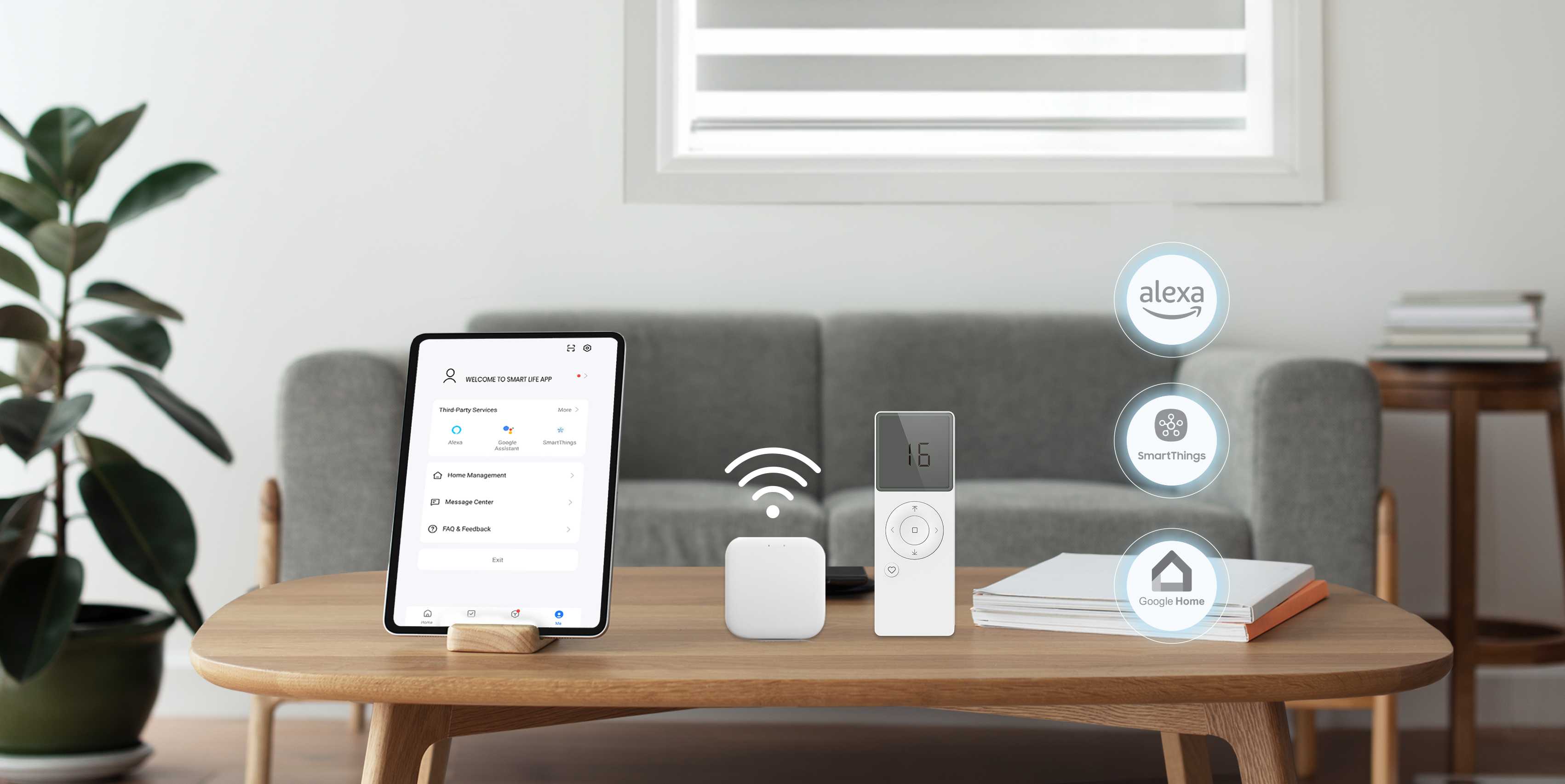
Platform by platform, as of 10 October 2026:
- Amazon Alexa: yes, through the Connector+ Hub and the Smart Life app. Link your Smart Life account to the Alexa skill and your shades appear as devices.
- Google Home / Google Assistant: yes, same route, through the hub and the app. (Tuya, the company behind Smart Life, lists Amazon Alexa and Google Assistant as its voice assistant integrations; Tuya, July 2026.)
- Apple HomeKit / Apple Home: no native support. Our shades do not show up in the Apple Home app. Tuya describes Siri control as working "through appropriate integration," which in practice means Siri Shortcuts triggering Smart Life scenes, not HomeKit. If your home runs on Apple Home, we are not the right fit, and we'd rather tell you now.
- Samsung SmartThings: the Smart Life app lists SmartThings among its third-party services, but we have not tested that link ourselves, so we don't promise it.
- Matter: not something we can verify for our Connector+ Hub as of October 2026. Don't buy our motors on the assumption that they'll be Matter devices.
The hub is a one-time $225.00 and one serves the whole home. Every compatibility claim here is dated for a reason: ecosystems change, and so will this page.
Battery Life Math
The formula: cycles per charge ÷ cycles per day = days between charges. Our motors are rated for up to 300 up/down cycles per charge; one cycle is one trip down and back up.
- Bedroom, down at night and up in the morning: 1 cycle a day. 300 ÷ 1 = about 300 days. Our motorization page quotes approximately six months with typical use, which allows for the odd extra adjustment, so plan on twice a year.
- Living room on a sun schedule, closing at mid-afternoon and opening at dusk, plus a morning run: 2 cycles a day. 300 ÷ 2 = 150 days, about five months.
- A kid's room that goes up and down all day: 4 cycles a day. 300 ÷ 4 = 75 days, about two and a half months.
Even the heavy case is a charge every season, not every month.
The cold-window caveat. Lithium-ion batteries give less when they're cold, and a motor sits right against the glass. In a Canadian January, on a draughty window, expect fewer cycles than the rating and charge a little sooner.
Charging, in practice. You don't take the shade down. You plug the cable into the motor, let it charge, unplug. Treat it like a furnace filter: two dates a year, every shade at once. Recharging is normal upkeep, not a warranty item (our 5-year warranty excludes recharging and routine motor maintenance, as of October 2026).
If a motor ever behaves oddly, we're in Toronto, not a call centre on another continent. Contact us for motor support and charging help, or ask at the showroom.
Who Should Skip Motorization
We'd rather sell you the right shade than the expensive one.
Skip it for a single, easy-reach window. If you can pull the chain in two seconds, a motor saves you two seconds and costs $495.00 plus a remote. That money buys a much better fabric, a blackout upgrade, or a second window done properly.
Skip it if the budget is tight. On a 36" × 60" roller in our entry fabric, motorizing one window, with its remote and hub, costs more than four chain-operated windows in the same fabric. Cover every window first and motorize the hard ones later. One catch: the motor is ordered as part of a new shade in the Control step, and we don't sell it separately as a retrofit kit as of October 2026, so decide per window at order time.
Skip it if you need Apple Home. See the compatibility section. We'd rather lose the sale than have you find out after install.
Skip it for a very narrow window. On our custom cellular shades the configurator only offers the motor from 19" wide, and on rollers and zebras it checks each size and won't show the motor where it doesn't fit. If the option isn't there, that's why.
Skip it if you hate charging anything. Twice a year is not much, but it is not zero. If that's a deal-breaker, you want a chain or our glide chainless lift, which needs nothing at all.
Go ahead if you have tall or unreachable windows, three or more windows to move together, a smart home you actually use, or a reason to want zero cords.
Ordering Motorized: What to Decide
Our configurator asks for the motor in the Control step, after shade type, size and fabric. Decide these before you get there.
- Control preference. Remote only, or app and voice too? Remote only is simpler and cheaper. App control adds the Connector+ Hub, once, and opens up schedules and voice.
- Which windows. List every window you want on a motor. The premium is per shade, so the list is the budget. Not sure? Start with one room and see whether the schedule life suits you before you do the whole house.
- Charging access. Can you reach the motor with a cable twice a year, by step-stool if not by hand? On a two-storey window, decide now how.
- Group planning. Which shades move together? Three bedroom windows on one channel, the living room on another. Sketch your groups before you pair.
- Control side. The configurator asks which side the motor sits on. Pick the side that's easier to reach with a cable.
- The chain-free bonus. For a child's room, this is the tiebreaker: a motorized shade has no cord to loop at all.
- Samples first. Order free samples of the fabric, then price one window in 60 seconds.
Shipping is free Canada-wide. Every shade is custom made in Toronto, Ontario, with about 2 business days of processing, then typically 3 to 9 business days of standard delivery in Canada, as of October 2026 (details in our shipping policy).
Motorized Blinds Buying Guide FAQ
How much do motorized blinds cost in Canada?
From us, as of 1 November 2026, at our sale price of 50% off retail: a motorized 36" × 60" roller shade runs $681.00 to $856.00 depending on fabric. The motor adds $495.00 to any roller or zebra shade, or $355.00 to a custom cellular. Remote $95.00 and hub $225.00, each bought once. Get your exact price.
Do motorized blinds work with Alexa and Google Home?
Ours do, through the Connector+ Hub ($225.00, one per home) and the free Smart Life app. There's no native Apple HomeKit support as of October 2026.
How long do motorized blind batteries last?
Up to 300 up/down cycles per charge, about six months with typical use. At four cycles a day, closer to every two and a half months. Charging is by cable with the shade in place.
Are motorized blinds worth the money?
For tall, unreachable or numerous windows, for accessibility, and for homes where the shades should follow a schedule, yes. For one easy-reach window on a budget, no; put the $495.00 into a better fabric.
Can motorized blinds be added to existing windows?
Yes. Our battery motors need no wiring, so they fit any existing window wide enough for the motor (from 19" on our cellular shades; the configurator checks rollers and zebras size by size). What we don't sell is a retrofit kit for a shade you already own; the motor is ordered as part of a new shade, as of October 2026.
Automation You Can Price First
Automation you can price before you fall in love with it. Shop motorized, or price one room in 60 seconds and see if the morning-schedule life is for you.