Most people come to cordless blinds for one of three reasons. There's a toddler in the house, or a grandchild who visits. There's a cat that treats a dangling chain as a personal invitation. Or you've simply wrestled one bead chain too many and you're done. Somewhere along the way you probably also heard that "corded blinds are banned in Canada", which is close to true but not quite.
This guide covers how cordless blinds actually go up and down (no magic, just a spring), where the real size limits are, what the Canadian cord rules do and don't say, and how to decide between cordless and motorized. Every price and limit below is dated, because they change.
How Cordless Actually Works
Our cordless option is called glide chainless. There's no chain and no cord. You hold the bottom bar and move the shade to where you want it. Pull it down a little, lift it up a little, let go, and it stays.
The thing doing the work is a spring inside the roller tube. Our ZeroGravity™ spring balances the weight of the shade, so the fabric feels close to weightless in your hand and doesn't creep up or slide down once you've let go. Drive wheels run inside the tube, and a foam layer around the aluminum shaft keeps the movement quiet. In practice it takes a light touch: one hand, one motion, done.
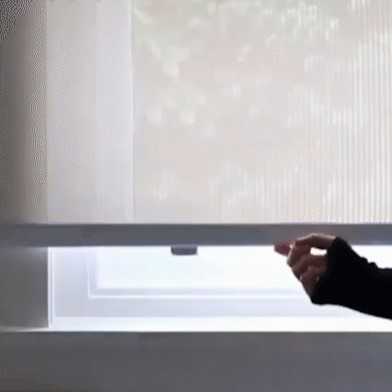
How it feels by product, as of October 2026:
- Roller shades: you move the whole shade by its aluminum bottom bar. Up for light, down for privacy, anywhere in between.
- Zebra blinds: same bottom-bar lift. The aluminum bar on our zebras holds the two layers of banded fabric together and aligned, so it doubles as your handle.
- Custom cellular shades: you lift or lower the shade at the bottom rail, and the same ZeroGravity™ spring keeps it where you leave it.
One practical point that follows from the design: you have to be able to reach the bottom bar. On a normal window that's never an issue. On a tall one, we come back to it in the limits section.
The Safety Story
Here's the accurate version of the Canadian rules, because the internet version is usually wrong in one direction or the other.
What the regulations are. Canada's Corded Window Covering Products Regulations came into force on May 1, 2021 (Justice Laws, SOR/2019-97, current to September 30, 2026). Health Canada says they cover corded window coverings "manufactured, imported, advertised or sold in Canada," custom-made and off the shelf alike (Health Canada industry guidance, page dated September 17, 2025).
What they require. Any cord a child can reach must be no longer than 22 cm when pulled, and any loop no bigger than 44 cm around. A cord that's unreachable has to stay unreachable whether the covering is fully open, fully closed or anywhere in between, for its whole useful life. Products also carry a bilingual strangulation warning.
What they don't do. They are not a ban on all corded blinds. A corded product that meets the limits can still be sold. And the rules govern what's made, imported, advertised and sold. They don't make it illegal to own the blinds already hanging in your house.
What Health Canada actually advises. Its home-safety page says children between 1 and 3 years old are most at risk, and that the safest window coverings are ones without long accessible cords. Its advice for older corded coverings at home is to replace them with newer ones, and until then to always keep cords out of a child's reach (Health Canada, Window covering safety, page dated September 17, 2025).
Where we stand. Our chain roller shades are built for these rules: every one comes with our Safety Shield, a tested device that meets the Canadian Corded Window Covering Regulations, with the chain concealed in it. That's a perfectly reasonable choice for an office or a guest room. But compliant and cordless aren't the same thing, and if you're furnishing a nursery, a kid's room, a playroom or anywhere a crib or bed sits near a window, the honest advice is to skip the chain entirely. No chain means nothing to tie up, wrap or check later.
Pets are the less-discussed half of this. A cat batting a chain, a dog that grabs anything that swings: none of that is a regulatory issue, and all of it is solved the same way.
Real Limits
Cordless isn't available on every size, and the reason is weight. The spring has to balance the full weight of the fabric and bottom bar. A bigger, heavier shade needs a bigger spring, and that bigger spring needs a wider shade to fit.
We ran our configurator's own compatibility check on 18 October 2026 for roller shades (a light privacy fabric and one of our heavier blackout fabrics) and zebra blinds. Here's what came back for glide chainless:
- Narrowest: 10" wide. Below that, it isn't offered.
- Up to 95" tall: available at every width we tested, from 10" up to 108".
- 96" tall and up: the shade moves to a larger spring, which needs the shade to be at least about 31" wide. A narrow, very tall window (say 24" wide and 96" tall) can't be glide chainless.
- Heavy fabric on very tall windows: with one of our heavier blackout fabrics, a few combinations around 36" to 38" wide and 108" to 120" tall came back unavailable, while wider shades at the same heights were fine.
On custom cellular shades, glide chainless is offered across our full cellular size range, 12" to 96" wide and 6" to 96" tall, as of October 2026.
You don't need to memorize any of this. When you type your width and height into the configurator, it runs the same check and only shows the controls that will work at that size. If glide chainless doesn't appear, that's why.
The reach question. Weight is one limit. Reach is the other. If the bottom bar of a fully raised shade ends up above where you can comfortably grab it (a transom, a two-storey window, a shade behind a deep kitchen counter), cordless is the wrong tool even when it's technically available. That's the line where motorized takes over. Our motorized blinds guide covers costs, batteries and smart home compatibility in detail.
Durability and Lifespan
The fair question about any spring is whether it wears out. Here's what we can and can't tell you.
What we can say: we don't publish a cycle rating for the glide chainless spring, so we're not going to invent one. The ZeroGravity™ system is designed to balance the shade evenly for smooth daily use. What we'd watch for on any spring-balanced shade is a shade that no longer stays put: it drifts up on its own, sinks after you let go, or suddenly feels much heavier than it used to.
What the warranty says, as of October 2026: our 5-year warranty covers manufacturing defects in materials and workmanship that appear within five years of the original purchase date. It doesn't cover normal wear and tear, damage from accidents or misuse, or problems caused by incorrect measurement or installation. If your lift misbehaves, contact us and our team will review it.
Two habits that help any cordless shade: move it by the bottom bar rather than tugging the fabric, and let it travel rather than forcing it past where it wants to stop.
Cordless Across Our Products
Here's who offers what, as of October 2026.
Roller shades. Three options: chain (included in the price), glide chainless, or motorized. Glide chainless adds $140.00 per shade. A 36" × 60" roller in our entry fabric tier with an open roll is $186.00 with chain and $326.00 glide chainless. See roller shades.
Zebra blinds. The same three options, and glide chainless is the same $140.00 per shade. See zebra blinds.
Custom cellular shades. Cordless by design: glide chainless is the standard lift and the price you see includes it. There's no chain option. A 36" × 60" custom cellular in our entry fabric group is $409.00 with glide chainless. See cellular shades.
Sheer shades. Chain or motorized. No glide chainless option, so if you want sheer without a chain, motorized is the route. See sheer shades.
Top-down/bottom-up. We don't offer top-down/bottom-up cellular shades as of October 2026.
All prices above are in CAD, per shade, as of 1 November 2026, at our sale price of 50% off our retail price. Watch for promotions, which can take it lower still. Shipping is free across Canada. Glide chainless used to cost more than it does now, so if you priced it earlier this year, check again.
Do cordless blinds cost more? On rollers and zebras, a little: $140.00 per shade over a chain. On custom cellular, nothing extra, because cordless is the only manual option.
Cordless vs. Motorized: How to Decide
Both get rid of the chain. The difference is how you move the shade and what you pay. Three questions settle it.
1. Can you reach the bottom bar? If yes, cordless is the natural choice. If the shade is high, over a counter or behind furniture, go motorized.
2. How many windows, and how often do you move them? One or two shades you adjust by hand once a day: cordless. A living room wall of five shades you want to move together, or on a morning schedule: that's what motorization is for.
3. What's the budget? On a 36" × 60" roller shade as of 1 November 2026, glide chainless adds $140.00 and motorized adds $495.00 per shade, plus a remote ($95.00) or smart hub ($225.00) if you want them. On custom cellular, stepping up from glide chainless to motorized adds $355.00 per shade. Motors also need occasional charging. Cordless needs nothing at all.
A mixed home is completely normal: cordless in the kids' rooms and wherever you can reach, motorized on the tall living room window. You can shop motorized solutions and cordless in the same order.
Cordless Blinds FAQ
How do cordless blinds work without a cord?
A spring inside the roller tube balances the weight of the shade. You move it by the bottom bar with a light touch, and it stays where you let go.
Do cordless blinds break easily?
They're built for everyday use. We don't publish a spring cycle rating, but our 5-year warranty covers manufacturing defects in materials and workmanship (not normal wear or misuse). Moving the shade by the bottom bar, not the fabric, is the best habit.
Are corded blinds illegal in Canada?
No. Since May 1, 2021, corded window coverings made, imported, advertised or sold in Canada must meet strict cord-length and loop limits. Compliant corded products can still be sold, and owning older blinds isn't illegal. Health Canada still recommends replacing coverings with long accessible cords.
What size is too big for cordless blinds?
On our rollers and zebras, as of October 2026: under 10" wide, or 96" or taller on shades narrower than about 31", isn't available, and a few very tall heavy-fabric sizes aren't either. The configurator only shows cordless when it works at your size.
Do cordless blinds cost more?
On rollers and zebras, glide chainless adds $140.00 per shade (as of 1 November 2026, at 50% off our retail price). On custom cellular, it's included.
Choose Cordless
No cords, no chains, nothing to childproof later. Shop cordless, the default that should have always been the default. Not sure which shade yet? Get a price in 60 seconds.