Learning how to measure windows for blinds is the one step that decides whether your custom order fits perfectly or arrives the wrong size — and it makes people nervous, understandably. You are about to spend real money on made-to-measure blinds, and it feels like a single bad number ruins everything.
Here is the good news, and the single most important thing on this page: you measure the opening, we do the math. You give Off Cut Shades the exact size of your window, and our Toronto factory applies the correct deductions before we cut a thing. There is no formula for you to get wrong. And if something still slips through, our Fit Guarantee has your back — more on that below.
Follow the steps here and you really can't mess this up. The method is identical for every custom blind and shade we make — so once you know how to measure for roller blinds, you can measure for zebra shades, sheers, or roller shades with exactly the same confidence. Grab a metal tape measure and let's go.
Before You Measure: 3 Rules
Read these first. They prevent almost every measuring mistake we see.
- Use a steel tape measure — never a fabric one. Cloth and vinyl tapes stretch and sag, and a stretched tape means a wrong number. A rigid metal tape is the only tool you need — ideally one marked in both inches and millimetres so you can read a precise number.
- Measure every window, even identical-looking ones. Two windows that look the same are often 1/4" (about 6 mm) apart. Openings settle and shift over the years, so measure each one on its own and label it.
- Always write it down as width × height, in that order. Width first, height second — every time. This is how you'll enter it when ordering, and mixing up the two is the easiest error to avoid.
The millimetre-vs-inch rule: measure as precisely as your tape allows — reading down to the millimetre is fine, and often more accurate than eyeballing an inch fraction. Just note that Off Cut Shades' order form is entered in inches, rounded down to the nearest 1/8" (and 1/8" ≈ 3 mm). So take a precise reading, then round down to the nearest 1/8" when you enter it — or tell us your millimetre figure and we'll convert it for you.
Do You Measure the Glass, the Frame, or the Opening?
This trips up almost every first-timer, so let's settle it up front: you measure the opening — never the glass. The pane of glass is smaller than the space your blind actually has to cover, so measuring it all but guarantees a blind that's too narrow and too short.
For an inside mount, the opening is the inside of the window frame — the recess the blind drops into. Put your tape against one inside edge of the frame and read across to the opposite inside edge. For an outside mount, the "opening" is really the stretch of wall or trim you want the blind to cover, plus your overlap. Either way you're measuring the air gap across the recess (or the wall), not the glass and not the lip of the sill.
Inside Mount vs Outside Mount
Before you touch the tape, decide where the blind will sit, because it changes how you measure.
- Inside mount — the blind sits inside the window frame for a clean, built-in look. You measure the exact opening.
- Outside mount — the blind mounts on the wall or trim above and around the opening. You measure the finished size you want the blind to be.
Not sure which one? See the section Which Mount Should You Pick? further down, or view the mounts side by side in our inside vs outside mount comparison.
Inside Mount: Step by Step
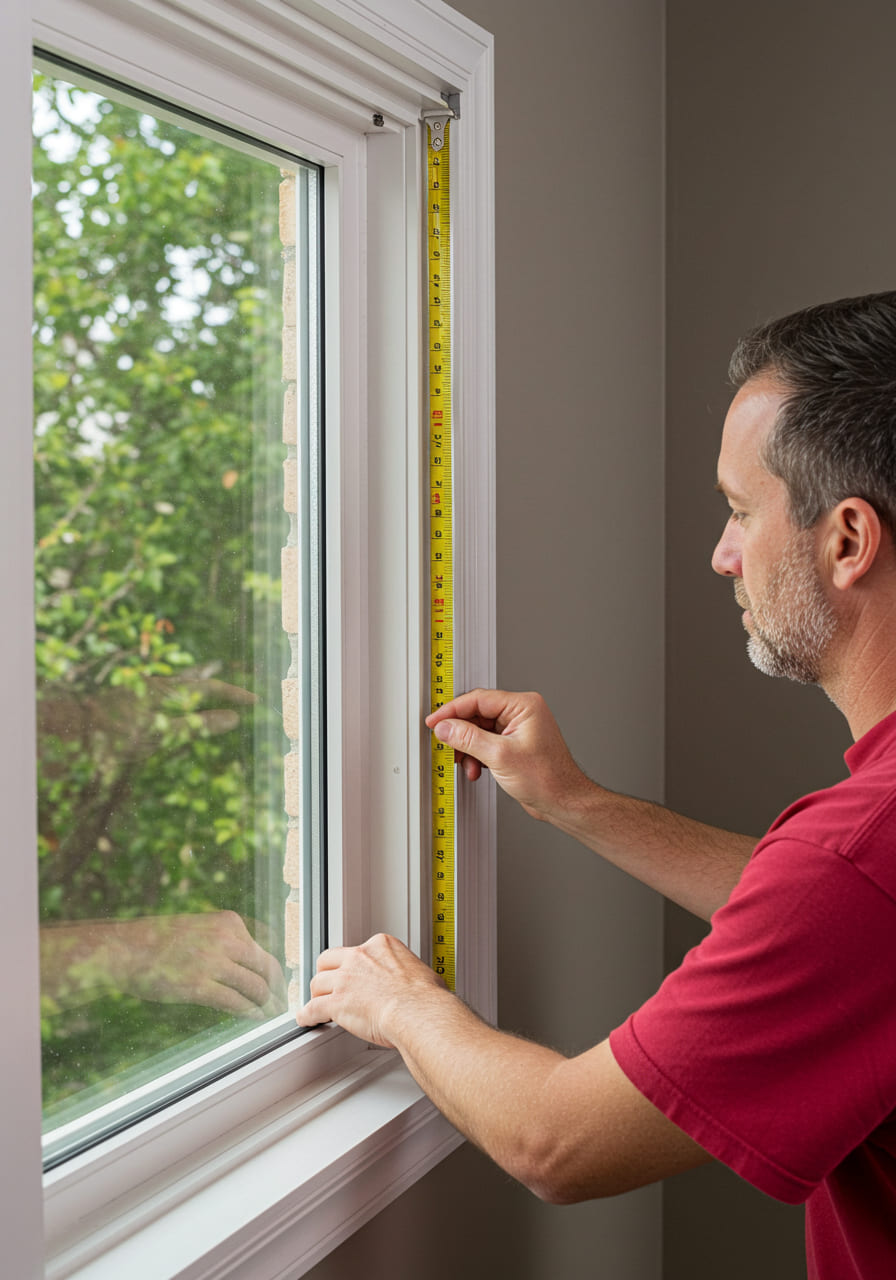
Every inside mount measurement rests on one promise: you give us the exact opening size and we do the rest. Do not subtract anything — we make the clearance deduction (about 1/8") for you.
Width
- Measure the inside width of the frame in three places: top, middle, and bottom.
- Windows are rarely perfectly square, so these numbers may differ.
- Record the narrowest of the three. Round down to the nearest 1/8 inch.
That narrowest width is the number you order. Taking the narrowest guarantees the blind clears the opening at its tightest point.
Height
- Measure the height from the top inside edge of the frame down to the sill in three places: left, centre, and right.
- Record the shortest of the three. Round down to the nearest 1/8 inch. Taking the shortest height is the number you enter, so the blind clears the sill everywhere without catching.
The rule to memorise: narrowest width, shortest height.
Depth check
Inside-mount blinds need enough flat depth inside the frame for the brackets — usually a minimum of about 2 inches (roughly 50 mm), and more if you've chosen a cassette or valance. Check the depth requirement on the specific product page before you order. If your frame is too shallow, switch to an outside mount.
Outside Mount: Step by Step
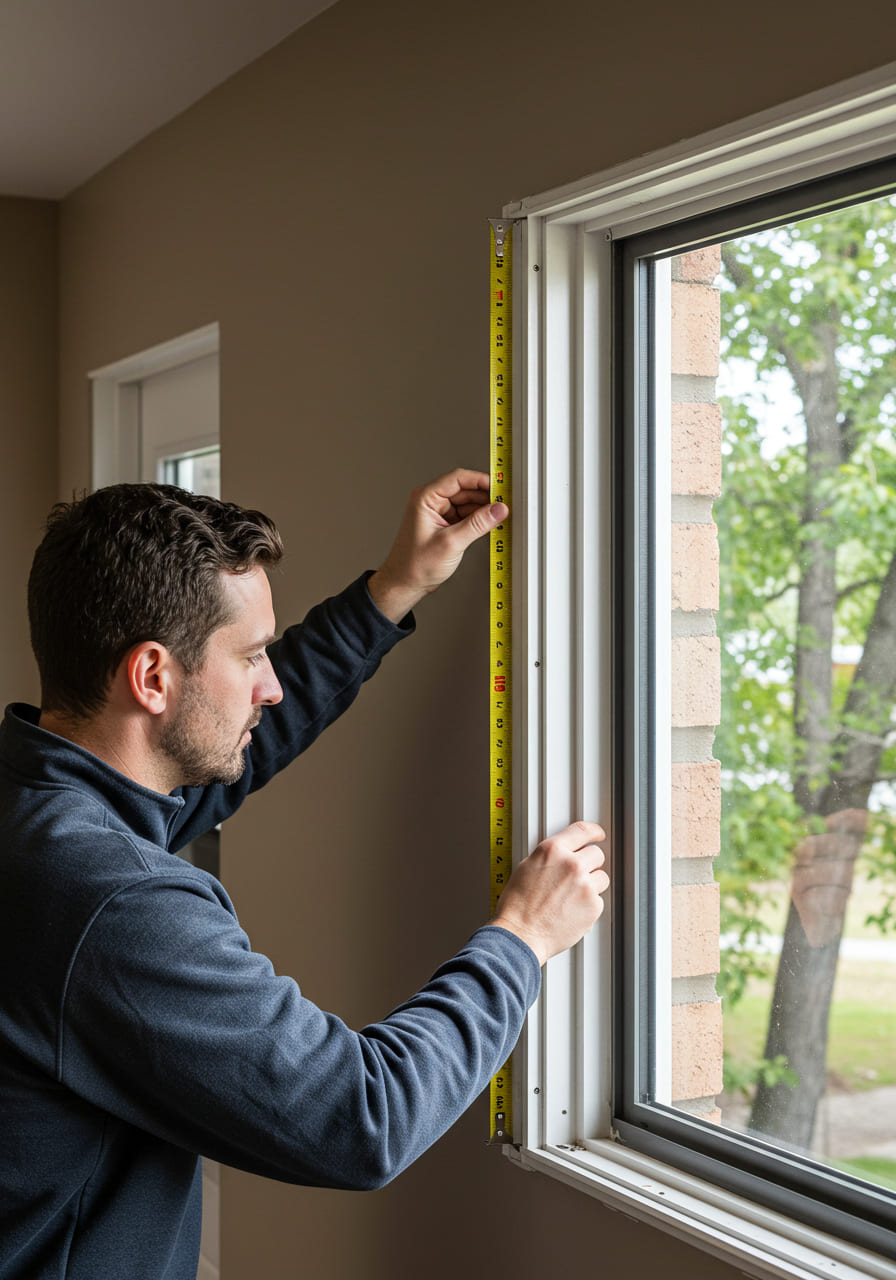
For an outside mount there are no deductions at all. We build the blind to the exact width and height you give us, so you measure the finished size you want to see on the wall.
- Add overlap for the width. For good light control and privacy, add at least 1.5 to 3 inches on each side of the opening (about 40–75 mm per side; 3–6 inches wider in total). Measure the full width you want the blind to cover, overlap included — that's your order width.
- Choose your top mounting point for the height. Make sure there's enough flat surface above the frame (about 2 inches) for the brackets. Measure from that point down to where you want the bottom of the blind to sit — the sill, or slightly below for fuller coverage.
- Account for handles and trim. If there's a crank, a protruding handle, or decorative trim, mount high enough and wide enough that the blind clears it and covers it cleanly.
Download the printable checklist. Jot down each window's numbers as you measure — it's a free, no-signup PDF in our window measuring guide.
Which Mount Should You Pick?
Here's the quick version — pick whichever list sounds like your window.
Choose inside mount if…
- Your frame is at least ~2" (about 50 mm) deep.
- You want a clean, recessed, built-in look.
- You're happy with tiny light gaps at the very edges.
Choose outside mount if…
- Your frame is shallow, or there's no usable depth.
- You want maximum light blockage and privacy.
- You want to make a small window look larger, or hide an out-of-square or worn frame.
Roller shades, zebra blinds, and sheers all take either mount the same way, so this one choice applies no matter which style you're ordering. Still torn? The full walk-through lives in our measuring guide.
Special Situations
A few windows need a small tweak — one fix each:
- Tile or quartz sills: measure to the point where the blind will actually rest; if the sill is uneven, an outside mount is more forgiving.
- Cranks and handles (casement windows): if the handle sticks out into the opening, choose an outside mount, or check that the blind's projection clears the handle.
- Doors (patio/French): account for the handle and add extra height so the blind clears it; outside mount is usually best.
- Shallow frames: if you can't hit the minimum depth, go outside mount.
- Out-of-square openings: trust the rule — narrowest width, shortest height — and let the deductions do the rest.
Common Measuring Mistakes to Avoid
Almost every wrong-size order traces back to one of these — and each is easy to dodge once you know it:
- Reusing one measurement across several windows. Even a row of identical-looking windows can vary by 1/4". Measure and label every opening.
- Deducting the clearance yourself. On an inside mount, send the exact opening — subtracting the 1/8" as well leaves the blind too narrow. We handle that.
- Measuring the glass instead of the opening. Always measure the frame recess (inside mount) or the area you want covered (outside mount).
- Using a cloth tape. It stretches, so the number drifts a few millimetres every time. Steel only.
- Guessing the depth. Confirm the frame is deep enough for an inside mount before you order — otherwise switch to an outside mount.
What Happens to Your Numbers at the Factory
Here's the trust part, and why measuring is safer than it feels.
- We apply the deductions. For an inside mount, you send the exact opening and we shave the small clearance (about 1/8") so the blind drops in smoothly. For an outside mount, we build to your numbers exactly. Either way, there is no math for you to do.
- We flag suspicious dimensions. Because every blind is cut here in Toronto rather than drop-shipped, our team eyeballs orders with unusual proportions and will reach out if a measurement looks off before anything is cut.
- The Fit Guarantee. If you accidentally mis-measure, contact us within 30 days of delivery for one complimentary adjustment or remake per eligible shade, up to four shades per household. Read exactly what happens if your blinds don't fit.
That's the whole point: you handle the tape, we handle the risk.
How to Measure Windows for Blinds: Your Printable Checklist
Run through this before you order. Want it on paper? Download the free printable worksheet from our window measuring guide and fill in one line per window.
☐ Used a steel tape measure
☐ Measured each window separately and labelled it
☐ Decided inside or outside mount
☐ Inside: recorded narrowest width, shortest height (exact opening — no deductions)
☐ Outside: recorded finished width with 1.5–3" overlap per side, plus finished height
☐ Checked frame depth (inside mount)
☐ Wrote everything as width × height, rounded down to the nearest 1/8"
Frequently Asked Questions
Do I measure the window or the blind size?
For an inside mount, measure the window opening and we make the deductions. For an outside mount, measure the finished blind size you want, including overlap.
Should blinds be wider than the window?
Only for outside mount — add 1.5 to 3 inches per side for privacy and light control. Inside-mount blinds sit within the opening at the size you provide.
What is the narrowest width rule?
For inside mounts, measure the width at the top, middle, and bottom and order the smallest of the three, so the blind clears the frame at its tightest point.
Do you deduct for inside-mount blinds?
Yes. Send us the exact opening width and we take off the small clearance (about 1/8") ourselves. Please don't subtract it yourself, or the blind will end up too small.
What if I measured my windows wrong?
Contact us within 30 days of delivery. Our Fit Guarantee covers one complimentary adjustment or remake per eligible shade, up to four shades per household.
Are millimetres or inches better for measuring blinds?
Either works for measuring — millimetres can even be more precise, so read whichever scale on your tape is clearer. For ordering, Off Cut Shades' form uses inches rounded down to the nearest 1/8" (1/8" ≈ 3 mm), so take your precise reading and round it down when you enter it. That rounding is not a deduction — you never subtract for clearance yourself; we handle all deductions. Measured in millimetres? Just send us the number and we'll convert it.
You Measure the Opening — We Do the Rest
You measure the opening; we do the math, the cutting, and the guarantee. Grab your tape, run through the checklist, and get a price in about 60 seconds.
Ready when you are — shop custom blinds, or order free samples first if you'd like to see the fabric in your own light before you commit.